

Florida Amendment 3: What a YES Vote and a NO Vote Mean
Election Day: Tuesday, November 3, 2026
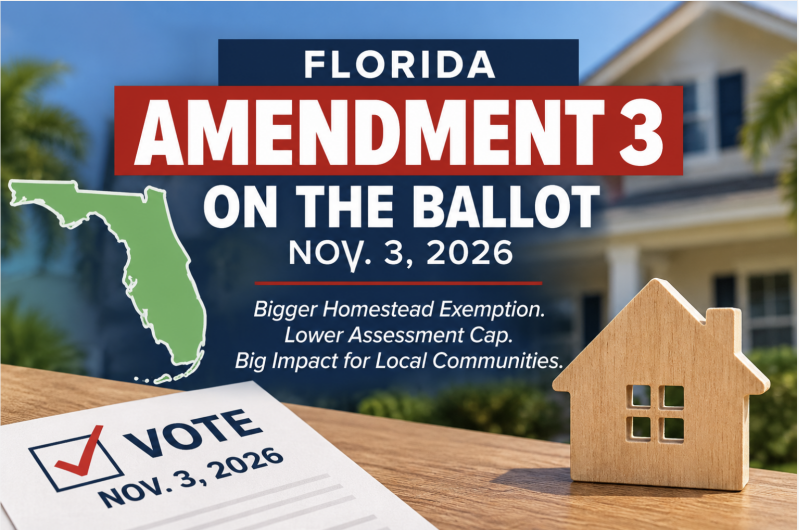
Just the facts - Amendment 3 could affect homeowners, landlords, investors and local governments differently. This page is intended to explain what the amendment says and what is known about its potential effects. It is not an endorsement or recommendation to vote for or against the amendment.
What is Amendment 3?
Amendment 3 is about property taxes. Property taxes are what people pay each year for owning a home or building. Your ballot will call it: "Increased Homestead Exemption; Lower Cap on Increases in Non-Homestead Property Assessments."
The 2 Definitions:
- Homestead exemption: If you own a Florida home and live in it full-time, part of its value is taken off before your taxes are figured. That part isn't taxed.
- Assessment cap: A limit on how fast the taxed value of a property can go up each year.

If YES wins
For people who live in the home they own:
- In 2027, the homestead exemption goes up to $150,000.
- In 2028, it goes up to $250,000.
- After 2028, that amount goes up with inflation.
- This change applies to city, county, and other local taxes only.
- School taxes do not change. School taxes still take off only $25,000.
People who move to Florida after December 31, 2026, start with the current, smaller exemption and get the bigger exemption starting in their 5th year of owning and living in their Florida home.
For rentals, second homes, vacation homes, and business property: Right now, the taxed value can go up as much as 10% a year. With yes, the most it can go up is 5% a year.
If YES wins, the changes start January 1, 2027.

If NO wins
- Nothing changes.
- Homeowners keep today's exemption of about $50,000.
- Rentals, second homes, and business property keep the 10% yearly cap.
- Property taxes keep working the way they do now.
- School taxes do not change. School taxes still take off only $25,000.
How many votes does it need?
Changing Florida's Constitution takes more than half the votes. Amendment 3 needs at least 60% YES votes to pass. If fewer than 60% of voters say YES, nothing changes.
Key dates for Duval County voters
- Voter registration deadline: October 5, 2026
- Deadline to request a mail ballot: 5 p.m., October 22, 2026
- Election Day: Tuesday, November 3, 2026, polls open 7 a.m. to 7 p.m.
- Early voting dates and locations: duvalelections.gov
What Amendment 3 does NOT change
Save Our Homes stays. The taxed value of your full-time home still can't go up more than 3% a year, or the inflation rate if that's lower.
Portability stays. You can still carry your Save Our Homes savings with you when you move to a new Florida home.
Other exemptions stay. Exemptions for seniors, veterans, people with disabilities, and widows and widowers don't change.
What Could It Mean for Local Government Revenue?
Florida’s Revenue Estimating Conference estimates that the amendment would reduce local government property-tax revenues as the provisions phase in, with the recurring impact eventually reaching an estimated $12 billion annually statewide.
The amount would vary among cities, counties and other taxing authorities depending on property values, exemptions, assessment growth and applicable tax rates.
Effect on local governments:
- Spend less or change what they spend on
- Raise other taxes or fees, where the law allows
- Use money they have saved
- Change tax rates on property that is still taxed, within legal limits
- Get money from the state, if lawmakers decide to give it
Does the amendment specify how that revenue would be replaced?
No. The amendment does not establish a dedicated $12 billion replacement fund for local governments. How individual governments respond to changes in property-tax revenue would be determined through future budgeting and policy decisions.
Where will local governments get the money not collected in property taxes?
If Amendment 3 passes, local governments would have several potential choices, depending on their circumstances:
- Reduce or reprioritize spending
- Increase other taxes or fees where legally permitted
- Use existing reserves or other revenue sources
- Adjust millage rates on property that remains taxable, subject to applicable limits
- Potentially receive future state assistance if the Legislature subsequently appropriates it
Who Could Be Affected?
Homeowners with a Florida homestead - Would be directly affected by the proposed increase in the homestead exemption for applicable local taxes.
Investment Property Owners - could be affected by the proposed reduction in the assessment-growth cap from 10% to 5%.
Renters - would not receive a homestead exemption directly because they do not own the property, but rental-property owners could be affected by the assessment-cap change.
What are the Potential Tradeoffs?
Potential benefits: Larger homestead exemption, lower non-homestead assessment cap, and potentially lower non-school property taxes for qualifying homeowners.
Potential concerns: Significant reductions in local property-tax revenue, no dedicated replacement funding in the amendment, and the possibility that local governments respond through spending reductions, tax/fee changes, or other revenue sources.
The outcome would vary by homeowner, property type, and local government.
Where to learn more
- Florida Division of Elections: dos.fl.gov/elections
- Duval County Property Appraiser: paduval.com
- Duval County Supervisor of Elections: duvalelections.gov
Last updated: September 2026. This page explains the facts only. It doesn't recommend how to vote. It isn't legal or tax advice. For how this would affect your own property, contact the Duval County Property Appraiser or a tax professional.