

Most people who drive down San Jose Boulevard think of it as a connector — a long road that runs past The Bolles School, through neighborhoods built in the 1980s, down to the Southside and back toward downtown. And for much of its length, that's exactly what it is.
But if you know where to turn, there's a different version of that road.
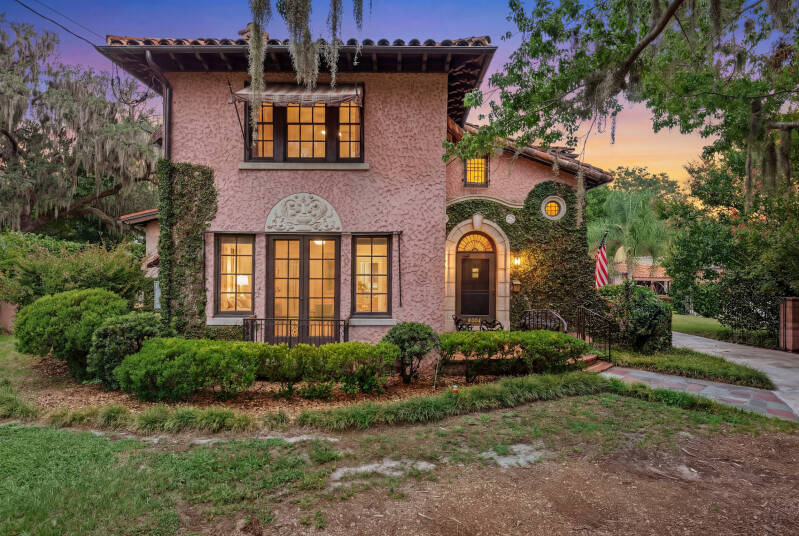
Where San Jose curves through the historic stretch toward the river — past homes built from the 1920s through the 1960s, through the tree canopy and the Spanish street names — you're no longer on a commuter corridor. You're on the spine of one of the most ambitious planned communities in North Florida history. And at 4004 San Jose Blvd, sitting in the Granada subdivision, there is a 1926 masonry estate with a provenance I have never seen matched in nearly two decades of working Jacksonville real estate.
The family that developed this neighborhood built this house. And they kept it for 100 years.
Granada, 1925
In 1925, Howard Properties platted the Granada subdivision along the river corridor of San Jose. The Spanish theme — Granada, Cordova, Seville — wasn't arbitrary. It was rooted in the actual history of this land, which had been a Spanish colonial plantation granted to Francis Xavier Sanchez by the Spanish government in the late 1700s. The developers leaned into that heritage deliberately, commissioning Mediterranean Revival architecture and dedicating Granada Park to Duval County as part of the original plat. That park still sits in the median of Granada Boulevard today, exactly where it was always intended to be.
The broader San Jose development of the 1920s brought in city planner John Nolen to lay out a master plan, architects Marsh & Saxelbye to design the civic buildings and signature residences, and Donald Ross — one of the most celebrated golf course designers of the 20th century — to design the country club course. The vision was a fully self-contained community: hotels, a yacht club, schools, shops, nearly 2,000 homes.
Then the Florida land boom collapsed. By the end of 1926, only 31 homes had been completed before all construction stopped. Most of the grand vision never got built. What remained were the street grid, the Spanish names, Granada Park, and a small number of homes — including one built by the family that made it all happen.
The House the Howards Built
The Howard family didn't just develop Granada. They built their home here, on San Jose Boulevard, in 1926 — the same year the boom ended and the neighborhood's future became uncertain.
And then they stayed.
For a century, this house has been in the hands of the family that platted the streets around it, dedicated the park down the road, and chose this particular piece of Jacksonville to put their name on. That is not a common story. In my experience, it is a rare one. A home with that kind of unbroken chain of ownership carries something that square footage and finishes can't capture: a sense of stewardship that runs through the walls.
I've written before about what I noticed walking through this property — the structural integrity of the original masonry, the proportions that still make sense for how people live today, the character details that no reproduction material can replicate. What I want to add now is this: all of that was maintained, generation after generation, by the people who built it. That matters to how a house ages. And this one has aged well.
Why This Stretch of San Jose Is Different
It's worth being specific about the geography, because San Jose Boulevard is not a single character from end to end.
The historic stretch — where Granada sits, where the river is close, where the homes run from the 1920s to the 1960s in Mediterranean Revival and mid-century styles — is a different place than the wider, busier sections of the road further south. It connects back to Hendricks Avenue, running through a part of Jacksonville that largely escaped the commercial pressure that reshaped other corridors. That relative preservation was partly intentional and partly accidental, but the result is a neighborhood that still reads like a neighborhood — not a transition zone or a development corridor.
4004 San Jose Blvd sits in that historic stretch. Its address is not incidental to its story.
Who This Home Is For
I want to be straightforward: this is not a home for everyone. A 1926 estate in Granada comes with the character that a century of history produces, and it asks something of its next owner — not just financially, but in terms of intention. The right buyer here understands the difference between updating a house and stewarding one.
If you are a preservation-minded buyer, a renovation investor who knows how to read what a property has been and what it can become, or someone who has simply always wanted to live in a piece of Jacksonville that most people don't even know exists — I'd like to show you this house.
Reach out and we'll set something up.
Joy Hicks, MBA, Realtor® SRES® — Seniors Real Estate Specialist | MRP — Military Relocation ProfessionalRE/MAX Specialists | Jacksonville, FL 📞 904.318.8619 | hicks.joy@icloud.com | www.JoyHicksRealtor.com Licensed Florida Real Estate Professional SL3620721. Serving Duval, St. Johns, Clay, and Nassau counties.
Add comment
Comments