


Should you renovate your Jacksonville home before selling? Sometimes, but not every project will pay for itself. The real question is not whether to renovate. It is which updates will actually make your home more competitive, which repairs could affect financing or inspection, and which projects you can skip without losing a dollar at closing. After nearly 20 years buying, renovating, and selling homes throughout Jacksonville, I walk sellers through exactly this decision before they spend a dollar preparing their home for the market.
Should You Renovate Before Selling Your Jacksonville Home?
The answer depends on four things: your home's current condition, what comparable homes in your area actually look like, what local buyers expect to see, and whether the likely increase in sale price covers the cost and time of the work. Those four factors matter more than any general rule about kitchens or bathrooms.
It helps to separate four categories of work before you spend anything. Repairs address a real problem, a leaking roof, failing HVAC, or active water intrusion, and these tend to affect financing, insurance, and inspection regardless of whether you renovate anything else. Cosmetic improvements change how a home presents, paint, lighting, hardware, and these are usually the highest return for the lowest cost. Larger renovations change the function or finish level of a space, a full kitchen remodel or a bathroom gut, and these only make financial sense when the home's condition and comparable sales support the investment. And some projects are ones many buyers would rather handle themselves, which means spending money on them before listing can work against you instead of for you.
A simple way to think about it: fix what is broken, present what is dated as clean rather than renovated, and save a full remodel for situations where the comparable sales in your specific neighborhood clearly reward it.
7 Home Improvements to Consider Before Selling in Jacksonville
- Fresh Paint and Cosmetic Updates
Paint is almost always the highest return project available to a seller, which is exactly why I wrote an entire piece on the paint colors that sell homes in Jacksonville. Fresh, neutral paint, updated lighting fixtures, and new cabinet hardware change how a buyer feels about a space without requiring construction. These updates help when walls show years of scuffs, when colors are highly personal, or when fixtures are visibly dated. They are unnecessary when the home is already neutral and well maintained, since repainting a perfectly fine wall color is money that does not need to be spent.
- Flooring and Overall Condition
Worn carpet, mismatched flooring between rooms, or visible damage reads as neglect to a buyer, even when the rest of the home is in good shape. A professional deep clean is always worth doing first, since it is inexpensive and sometimes solves the problem entirely. Replacement makes sense when carpet is stained or worn beyond cleaning, or when flooring is actively damaged. It usually does not make sense to replace flooring that is simply dated but in good condition, especially if many buyers in your price range plan to replace flooring themselves anyway.
- Kitchen Updates
The kitchen is where sellers most often overspend. A full remodel, new cabinets, new countertops, a new layout, is rarely justified unless your home is priced at the top of its comparable range and competing against recently renovated listings. Targeted updates usually make more sense: refinishing or painting cabinets instead of replacing them, updating hardware and lighting, and addressing anything visibly broken, like a cabinet door that will not close. The test I use with clients is simple. Does the kitchen function and look clean, or does it look broken and dated? Clean and dated can often be staged around. Broken and dated usually needs attention.
- Bathroom Improvements
Bathrooms get similar treatment. Visible repairs, a loose vanity, failing caulk, a running toilet, should always be addressed, since these read as neglect out of proportion to their actual cost. Lighting, hardware, and a thorough deep clean go a long way toward making a dated bathroom feel presentable rather than worn out. A full renovation only tends to make sense when the bathroom has a genuine functional problem or when comparable sales in your specific area show renovated bathrooms commanding a meaningfully higher price.
- Curb Appeal and Landscaping
Buyers form an opinion before they get out of the car, and in Jacksonville's climate, exterior maintenance shows fast. Overgrown landscaping, faded mulch, pressure washable grime on siding or walkways, and a tired front entry all affect that first impression disproportionately to their cost. This is usually a weekend project, not a renovation, and it is one of the few places where a modest investment reliably pays for itself in how the home is perceived before a buyer ever walks inside.
- Roof, HVAC, Plumbing, and Other Significant Repairs
These are different from everything else on this list, because they affect more than buyer perception. An aging roof, failing HVAC, or known plumbing issues can affect a buyer's financing, their inspection contingency, and in Florida, their ability to get insurance at a reasonable rate. I am not an insurance underwriter, and every carrier evaluates risk differently, but I can tell you from experience that major system issues tend to surface during the inspection process one way or another, either as a repair request or a renegotiated price. Evaluating these repairs before listing is less about adding value and more about avoiding a late stage surprise that costs you leverage at the worst possible time.
- Staging and Strategic Home Preparation
Staging is frequently the better investment compared to remodeling, and I say that as someone who genuinely loves a good renovation. Decluttering, rearranging furniture, improving lighting, and presenting a home so buyers can picture themselves in it often changes a buyer's impression more than a new backsplash would. The right strategy depends entirely on the home. A dated but well cared for house usually benefits more from strong staging than from construction.
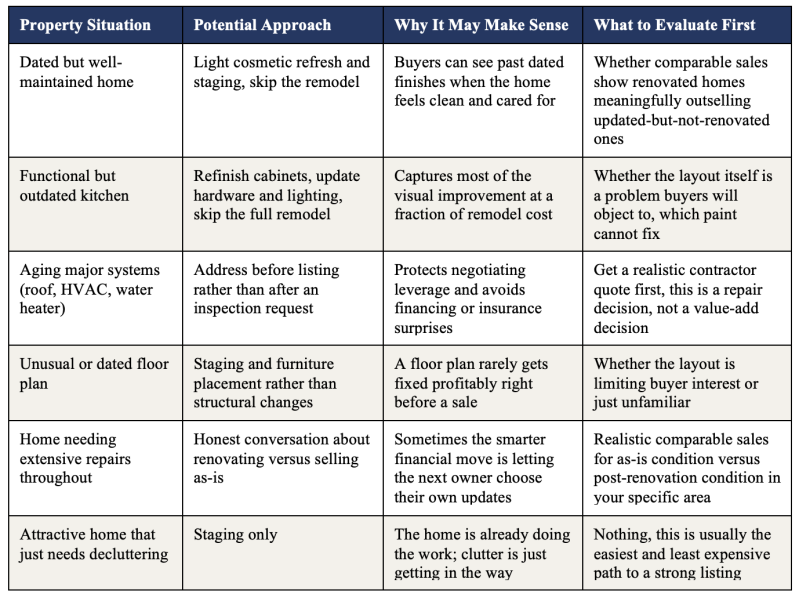
What I Would Fix Before Selling a Jacksonville Home, and What I Would Leave Alone
These are the kinds of decisions I walk through with clients, not universal rules. Every property is different, and the right call depends on your specific home and your specific comparable sales.
Should You Renovate or Sell Your Jacksonville Home As-Is?
A simple way to compare renovating against selling as-is is to estimate your net proceeds under each scenario separately, then compare the two numbers rather than comparing effort or stress. Under the renovate scenario, you start with the expected sale price after improvements, then subtract renovation expenses, subtract carrying costs for the additional time the project adds before listing, and subtract any other costs the project creates along the way. Under the as-is scenario, you start with the expected as-is sale price, then subtract your normal selling expenses. Whichever number is genuinely higher, not the one that feels more satisfying, is usually the right financial answer.
The hard part is getting realistic numbers for both sides. Comparable sales need to reflect your actual neighborhood and condition, not a national average. Renovation costs need to come from an actual contractor estimate, not a rough guess, and that estimate should account for Jacksonville's permitting timelines and the real possibility of delays. Selling as-is does not eliminate your disclosure obligations as a seller, so if you go that route, confirm what you are required to disclose with a qualified Florida real estate attorney rather than assuming as-is means no disclosure.
For a detailed breakdown of typical seller costs in this market, see my guide on how much it costs to sell a house in Jacksonville. And if you are weighing this same renovate-versus-updated question from the buying side, I covered that angle in Renovation Isn't Always the Answer: Why Turnkey Might Be Right for You.
How Much Should You Spend Preparing Your Home for Sale?
There is no fixed dollar amount or percentage of your home's value that makes sense for every seller, and I am skeptical of anyone who gives you one without seeing your home. A better approach starts with an honest look at your property's current condition, followed by a review of relevant comparable sales in your specific area, not the broader Jacksonville market. From there, identify the objections a buyer is actually likely to raise, get realistic cost estimates for addressing them, and compare the expected benefit against the total cost and the time the project will add to your timeline. The goal is to set a budget and a stopping point before you start, not to keep spending because one project led to another.
Jacksonville Neighborhoods Require Property-Specific Decisions
Renovation decisions do not look the same everywhere in Jacksonville, and that is not about one neighborhood being better than another. It is about what buyers in that specific area expect and what the properties themselves typically need.
Historic homes in San Marco and Riverside often come with older systems and original character features that buyers specifically want preserved, which changes the renovation conversation entirely. A full modern remodel can sometimes work against a historic property's appeal rather than for it. Established homes in San Jose and Mandarin tend to range widely in age and condition even within the same street, so the right answer depends far more on the individual property than the neighborhood as a whole. Homes in Ortega often carry similar considerations to San Marco and Riverside, given the concentration of older, architecturally distinct properties. Homes near the Beaches face their own climate considerations, since salt air and humidity are harder on exteriors and systems, which can shift priority toward maintenance related repairs over cosmetic ones. And properties in St. Johns County are frequently newer construction, where the renovation conversation looks different again, often centering more on personalization than on age related wear.
I am not going to tell you every home in any of these areas needs the same approach, because that would not be true. What I can tell you is that the right renovation decision always starts with your specific property and the comparable sales around it, not a generic rule about the neighborhood.
A Real-World Renovation Lesson
This is one actual property I worked on, not a general example. A small three bedroom, one bath home on Pinewood Avenue was being sold by a family of five who had outgrown the space. The kitchen had been remodeled in the 1990s, so it was not original to the house, but it was dated and did not have a dishwasher. Otherwise the home was well maintained, aside from a damaged front door, peeling paint in the bathroom, and a water stained wall under a window where a leak had occurred years earlier.
We sat down and built a punch list together. On the front door, we replaced it entirely and added new hardware and fresh paint, since a damaged entry door is one of the first things a buyer notices. We cleaned and decluttered the whole house, including boxing up a significant amount of toys and belongings that were not essential to showing the home. In the bathroom, we scraped the peeling paint, repainted in a light white, and repaired the damaged wall so it no longer looked like the house needed work.
What we did not do was remodel the kitchen. It was dated, but it was clean, functional, and not broken, which matched the exact test I described earlier in this article. A full kitchen remodel on a small starter home like this one would not have been recovered in the sale price, and it would have delayed listing for no real benefit. The home sold within a month of listing. The lesson is not that cosmetic fixes always beat bigger projects. It is that matching the right level of work to the right property is what actually moves the needle.
Frequently Asked Questions About Renovating Before Selling
Is it worth renovating a house before selling in Jacksonville, Florida?
Sometimes, but not automatically. It depends on your home's condition, what comparable homes nearby actually look like, and whether the likely increase in sale price covers the renovation cost and added time. Cosmetic updates and necessary repairs are worth it far more often than a full remodel.
What renovations add the most value to a Jacksonville home?
Fresh neutral paint, updated lighting and hardware, strong curb appeal, and professional staging tend to offer the best return relative to cost. Addressing roof, HVAC, or plumbing issues protects your negotiating position even when it does not directly raise your sale price.
Should I remodel my kitchen before selling my house?
Usually not a full remodel. Targeted updates, refinished cabinets, new hardware, updated lighting, capture most of the visual benefit at a fraction of the cost. A complete remodel only tends to make sense for homes priced at the top of their comparable range.
Should I sell my Jacksonville home as-is or make repairs first?
Compare your estimated net proceeds under both scenarios using realistic comparable sales and actual contractor quotes. Selling as-is can be the right call for homes needing extensive work, but it does not remove your disclosure obligations as a seller.
How much should I spend preparing my home for sale?
There is no fixed percentage that applies to every home. Start with your property's actual condition and local comparable sales, identify likely buyer objections, get real cost estimates, and set a budget and stopping point before you begin.
Who can help me decide which renovations are worth making before selling?
A local real estate professional with genuine renovation experience can walk your home with you and evaluate it from both angles at once. That combination is exactly what I bring to this conversation with my clients.
Make a Smarter Renovation Decision Before You Sell
You do not have to guess which projects are worth your time and money, and you do not need to assume a full remodel is required before you can list your home. The better path is an honest evaluation of your specific property, realistic comparable sales, and real cost estimates, not a generic checklist.
Thinking about selling your Jacksonville home but not sure what to fix first? Before you spend thousands of dollars on renovations, let's evaluate your options together. With nearly 20 years of renovation experience and a background in residential real estate, I can help you think through which improvements are worth making, which ones you can skip, and how to prepare your home for the market with confidence. Visit www.JoyHicksRealtor.com to connect with me, or reach out directly below.
Joy Hicks, MBA, Realtor®
CLHA® - Certified Luxury Home Agent
SRES® – Seniors Real Estate Specialist
MRP® – Military Relocation Professional
HSR® - Home Stager and Redesigner Certified
RE/MAX Specialists
904.318.8619
hicks.joy@icloud.com
www.JoyHicksRealtor.com
Add comment
Comments