

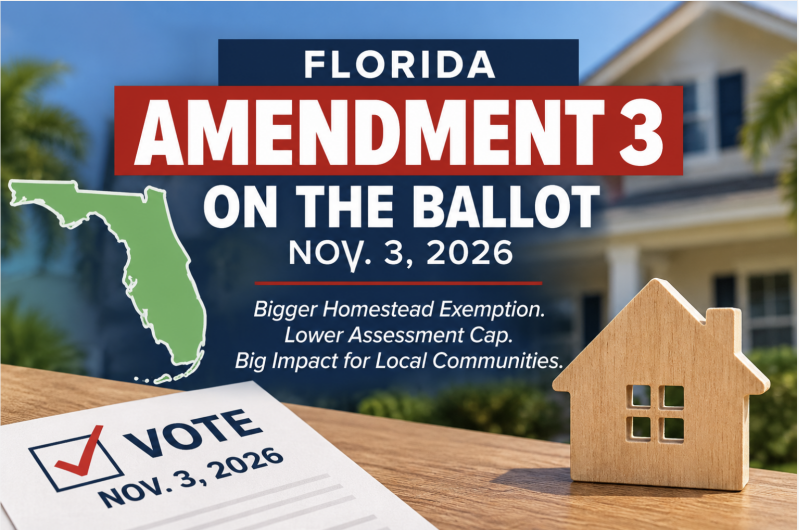
On November 3, Florida voters decide the fate of Amendment 3, a property tax measure that could change what homeowners, renters, and investors pay starting in 2027. Whichever way you lean on it, here is what it changes, point by point, and what it means for anyone buying, selling, or holding property in Jacksonville.
What Amendment 3 Changes, in Plain English
Amendment 3 is a constitutional ballot measure, officially titled “Increased Homestead Exemption; Lower Cap on Increases in Non-Homestead Property Assessments.” Like every constitutional amendment in Florida, it needs at least 60% of the vote to pass, not a simple majority.
If it passes, the homestead exemption for city, county, and other local taxes rises to $150,000 in 2027 and $250,000 in 2028, then adjusts for inflation after that. School taxes are not affected: that exemption stays at $25,000 either way. Separately, the cap on how much a non-homestead property's taxable assessment can increase each year, think rentals, second homes, and business property, drops from 10% to 5%. Both changes would take effect January 1, 2027.
If it fails, nothing changes. The homestead exemption stays close to where it is now, and the 10% non-homestead cap remains in place.
What Stays the Same Either Way
A few things are not on the ballot, no matter how this vote goes. Save Our Homes, the cap that limits how much your homesteaded property's assessed value can rise each year to 3% or the inflation rate, whichever is lower, is untouched. Portability, the ability to carry your accumulated Save Our Homes savings to a new homestead, is untouched. So are the existing exemptions for seniors, veterans, people with disabilities, and surviving spouses. If you already own a homesteaded property in Jacksonville, those protections hold regardless of Tuesday's outcome.
What This Means If You Already Own a Home Here
If you have a homestead exemption on your Jacksonville home, a YES result would lower your non-school property tax bill starting with your 2027 assessment, though the exact dollar amount depends on your home's assessed value and your local millage rate. A NO result simply keeps things as they are. Either way, there is nothing you need to do right now. The exemption increase, if it passes, applies automatically to existing homesteads. It is worth checking your 2027 TRIM notice next August to see how it lands on your actual bill.
What This Means If You're Buying Before the End of the Year
Here is a timing detail worth knowing if you are relocating to Florida and shopping for a home right now. The amendment specifies that anyone who was not a Florida resident as of December 31, 2026 would start with the current, smaller exemption and only grow into the full $150,000 to $250,000 exemption in their fifth year as a homesteaded owner. If you are already a Florida resident, that phase-in does not apply to you. It only matters for buyers moving to Florida from out of state, and only if the amendment passes. It is a detail worth asking your lender or closing attorney about if your move date is close to the new year, not a reason to rush a purchase.
What This Means If You Own Rental or Investment Property
For landlords and investors, the more consequential piece is the assessment cap, not the homestead exemption. Cutting the annual increase cap on non-homestead property from 10% to 5% would slow how fast a rental or investment property's taxable value, and therefore its tax bill, can climb in a strong market. That is generally favorable for investors holding property long term, though it also means a recent purchase still works its way toward full market value assessment, just more gradually either way. If you are running numbers on an investment purchase in Duval, St. Johns, Clay, or Nassau County, it is worth modeling both scenarios before you lock in a long-term hold strategy.
What Local Governments Might Do
The amendment does not come with a replacement funding source. The state's own estimate puts the recurring hit to local property tax revenue at roughly $12 billion a year statewide if it passes, and that number would play out differently city by city and county by county. Local governments could respond by adjusting millage rates, drawing down reserves, trimming spending, or asking the state Legislature for aid. None of that is guaranteed, and none of it is something any single homeowner controls. It is simply part of the picture worth understanding before results come in.
The Smart Move, No Matter How Tuesday Goes
If you are mid-transaction right now, in contract, closing soon, or weighing an offer, do not let the uncertainty around this vote stall your decision. Neither outcome changes your 2026 tax bill, and neither one should override the fundamentals of the home and the deal in front of you. What it should do is prompt a quick conversation with your lender, closing attorney, or tax professional about how either result might shape your 2027 numbers, especially if you are relocating from out of state or evaluating an investment property.
I put together a full, nonpartisan breakdown of Amendment 3, including key dates for Duval County voters, on my site at joyhicksrealtor.com/amendment-3. It walks through the YES and NO scenarios side by side without telling you how to vote, because that part is yours to decide.
Frequently Asked Questions
What is Florida Amendment 3 on the November 2026 ballot?
It is a constitutional amendment that would raise the homestead exemption for non-school property taxes to $150,000 in 2027 and $250,000 in 2028, and lower the annual assessment increase cap on non-homestead property from 10% to 5%. It needs at least 60% of the vote to pass.
Does Amendment 3 change the Save Our Homes cap?
No. Save Our Homes, the 3% (or inflation, whichever is lower) cap on assessment increases for homesteaded property, stays exactly as it is regardless of how the vote goes. Portability also stays unchanged.
How would Amendment 3 affect rental and investment properties in Jacksonville?
It would lower the annual cap on taxable assessment increases for non-homestead property, including rentals and second homes, from 10% to 5%, which would slow how quickly a property's tax bill can climb in a rising market.
What happens if Amendment 3 doesn't pass?
Nothing changes. The homestead exemption stays at its current level, and the 10% cap on non-homestead assessment increases remains in place.
When would Amendment 3's changes take effect?
If approved, the changes would take effect January 1, 2027, so they would first show up on 2027 tax bills, not the current year's.
Let's Talk Through What It Means for You
This post is general information, not tax or legal advice. For how any of this applies to your specific property or situation, talk with the Duval County Property Appraiser's office or a qualified tax professional. For buying, selling, or just making sense of what a tax change means for your next move in Jacksonville, I am always glad to help.
Joy Hicks, MBA, Realtor®
CLHA® – Certified Luxury Home Agent
SRES® – Seniors Real Estate Specialist
MRP® – Military Relocation Professional
HSR® – Home Stager and Redesigner Certified
REMAX Specialists
904.318.8619
hicks.joy@icloud.com
www.JoyHicksRealtor.com
Add comment
Comments