

Should you buy a fixer-upper in Jacksonville? The answer has less to do with how much you love the house and more to do with whether you have calculated the real cost of owning it, not just the purchase price and a rough renovation guess. The real cost includes the work itself, the money tied up while that work happens, and the surprises that almost always show up once walls are opened. Get those numbers right before you write an offer, and a fixer-upper can be one of the smartest buys in this market. Get them wrong, and the house that looked like a deal becomes the one that costs you the most.
Should You Buy a Fixer-Upper in Jacksonville?
A fixer-upper can be a smart buy when the purchase price plus a realistic, contractor-verified renovation budget still lands meaningfully below what comparable renovated homes in the same area are selling for, and when you have both the cash reserve and the timeline flexibility to absorb delays. It is usually the wrong buy when the discount on the purchase price barely covers the renovation cost you can actually verify, or when you are counting on your own labor and time to make the math work without a backup plan if that time does not materialize.
The mistake I see most often is buyers pricing the house and guessing at the renovation. The house has a real number attached to it, the renovation almost never does until someone who does this work walks it and gives you an actual bid.
The Real Cost Formula Before You Make an Offer
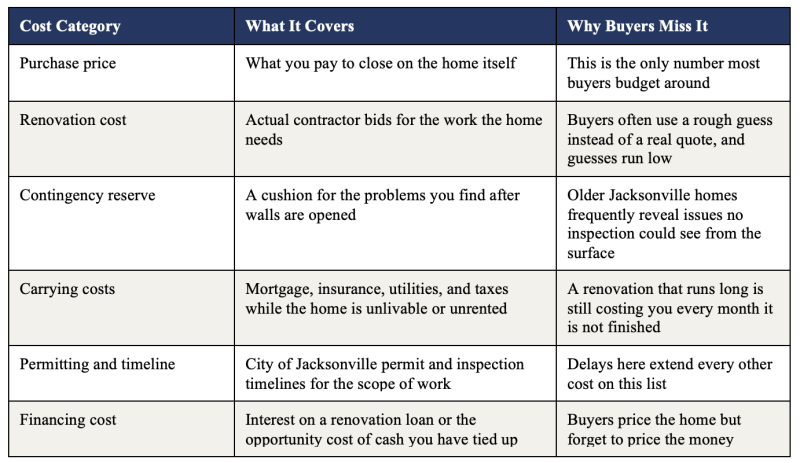
Purchase price alone tells you almost nothing about what a fixer-upper will actually cost you. A more complete picture looks like this: purchase price, plus verified renovation costs, plus a contingency reserve, plus carrying costs for the time the project takes, plus the cost of whatever financing you use to fund it. Every one of those categories is a real dollar amount, and skipping any of them is how a good deal on paper turns into a break-even sale two years later.
How to Estimate Renovation Costs Before You Make an Offer
The only renovation estimate worth using in your offer math is one from someone who has actually looked at the property, not a national average pulled from a website. Before you write an offer on a fixer-upper, walk the home with a contractor or an experienced renovation-focused agent and get a real range for the work it needs. If that is not possible before your offer deadline, build in an inspection contingency long enough to get that number before you are locked into the purchase.
Jacksonville's older housing stock adds a layer most national advice does not account for. Homes built before the 1980s often carry outdated electrical panels, galvanized or cast iron plumbing, and roofing or HVAC systems well past their expected life. None of that shows up in a listing photo, and all of it affects your renovation number, your financing, and in some cases your ability to get insurance at a reasonable rate.
Jacksonville-Specific Considerations for Fixer-Upper Buyers
Permitting timelines in Jacksonville can extend a renovation well beyond what buyers from out of market expect, and every week a project runs long is another week of carrying costs. Historic districts in San Marco, Riverside, Avondale, and Ortega often carry additional review requirements for exterior changes, which can affect both your timeline and what you are allowed to change. Properties near the Beaches or in flood-prone areas may face higher insurance costs or require flood-specific repairs that general renovation estimates do not capture. None of this means a fixer-upper in these areas is a bad idea, it means the real cost calculation has to reflect the specific property and the specific neighborhood, not a generic renovation budget.
When a Fixer-Upper Is a Smart Buy, and When to Walk Away
A fixer-upper tends to be a smart buy when the home's structural systems, the roof, foundation, and major mechanicals, are sound, and the work needed is mostly cosmetic or systems-level rather than structural. It also tends to work out when the neighborhood's comparable sales clearly support the value of a renovated home, so the math has somewhere to land. It is usually smarter to walk away when the renovation budget is based on a guess rather than a bid, when the timeline assumes nothing will go wrong, or when the purchase price was only a modest discount to begin with, leaving no real cushion once renovation and carrying costs are added in.
I covered the buyer side of this same renovate-versus-updated decision in more detail, including when a move-in ready home is actually the smarter financial choice, in
Renovation Isn't Always the Answer: Why Turnkey Might Be Right for You.
Frequently Asked Questions About Buying a Fixer-Upper
Is it worth buying a fixer-upper in Jacksonville?
Sometimes. It depends on whether the purchase price plus a contractor-verified renovation budget still lands well below comparable renovated homes nearby, and whether you have the cash reserve and timeline to absorb delays. A fixer-upper with a thin discount and a guessed renovation budget is usually not worth the risk.
How do I calculate the real cost of a fixer-upper before making an offer?
Add the purchase price, a contractor-verified renovation estimate, a contingency reserve for unexpected issues, carrying costs for the renovation timeline, and the cost of whatever financing you use. Comparing that total to local comparable sales tells you whether the deal actually works.
What renovation costs do fixer-upper buyers usually forget?
Carrying costs during construction, a contingency reserve for issues found once walls are opened, permitting timelines, and the interest or opportunity cost on the money funding the renovation are the most commonly missed categories.
Should I get a renovation estimate before or after making an offer?
Before, whenever possible. If your offer timeline does not allow it, build an inspection contingency long enough to get a real contractor estimate before you are locked into the purchase, rather than relying on a guess.
Are older Jacksonville homes more expensive to renovate?
Often, yes. Homes built before the 1980s frequently have outdated electrical, older plumbing, and aging roofing or HVAC systems that are not visible in listing photos. These add real cost that a generic renovation budget will not capture.
Who can help me evaluate whether a fixer-upper is a good investment?
A real estate professional with genuine renovation experience can walk the property with you and evaluate both the real estate value and the realistic renovation cost at the same time. That combination is exactly what I bring to this conversation with my buyers.
Make a Confident Decision Before You Offer on a Fixer-Upper
A fixer-upper is not automatically a good deal or a bad one. It is a math problem, and the buyers who do well with them are the ones who solve that math before they write an offer, not after.
Thinking about buying a fixer-upper in Jacksonville but not sure the numbers actually work? Let's walk the property together and build a realistic cost picture before you make an offer. With nearly 20 years of renovation and real estate experience, I can help you evaluate what a home really needs, what it will really cost, and whether it is the right buy for your goals. Visit www.JoyHicksRealtor.com to connect with me, or reach out directly below.
Joy Hicks, MBA, Realtor®
CLHA® - Certified Luxury Home Agent
SRES® – Seniors Real Estate Specialist
MRP® – Military Relocation Professional
HSR® - Home Stager and Redesigner Certified
RE/MAX Specialists
904.318.8619
hicks.joy@icloud.com
www.JoyHicksRealtor.com
Add comment
Comments